GO BACK TO THE WEBSITE HOME PAGE
DESCRIPTION:
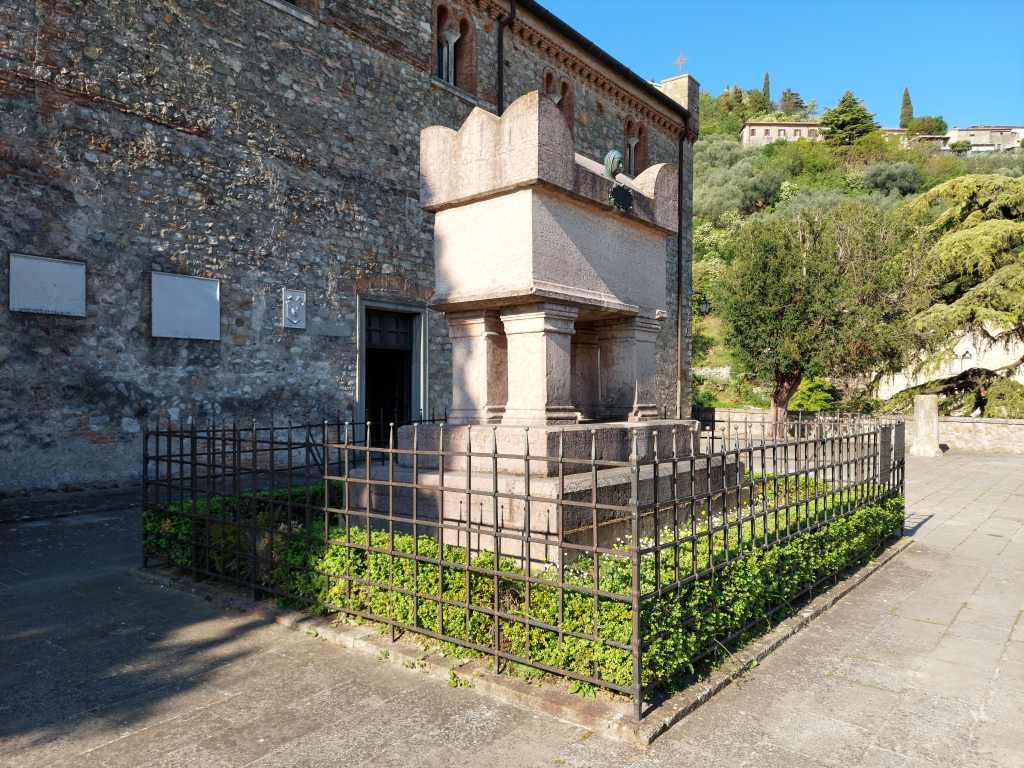
At the time of Francesco Petrarca’s death, the chapel he had wished for had not yet been built. For this reason, his body was initially placed in the archpriestal church of Arquà, where it remained until, six years later, it was transferred to the famous sarcophagus that still dominates the main square today.
Thus, the poet was laid to rest in Arquà, according to his wishes, although the Carraresi family and several Paduan humanists would have preferred that he be buried in Padua. Supporting the decision to leave him in Arquà was his son-in-law, Francescuolo da Brossano, who inherited the poet’s spiritual and emotional legacy.
It is said that Giovanni Boccaccio himself warned Brossano with these words: “The tombs of great men must either remain unknown or correspond magnificently to their fame.” For this reason, he chose an intermediate solution: he commissioned a sarcophagus made of red broccatello di Verona marble, in the Roman-Christian style, inspired by monuments such as the so-called Tomb of Antenor and the Tomb of Rolando da Piazzola in Padua.
An ancient inscription recounts its construction:
“Li fu fatta un’archa di pietra rossa all’antica, et messo dentro l’archa sopra quattro collone et messa sul sacrato di ditta chiesa. E’ la nobil archa de sodo sasso.”
“An ark of red stone was built for him in the ancient style, placed upon four columns and set on the churchyard of that church. It is the noble ark of solid stone.”
Today, this imposing sarcophagus — simple yet solemn — remains one of the symbolic landmarks of Arquà Petrarca, a meeting point for visitors wishing to pay homage to the poet.
The funerary monument of Petrarch impresses with its austere solemnity. The structure rests on a base of three steps, while the sarcophagus itself appears suspended on four pillars, surmounted by a monolithic double-pitched lid that recalls the style of ancient Roman and Christian tombs.
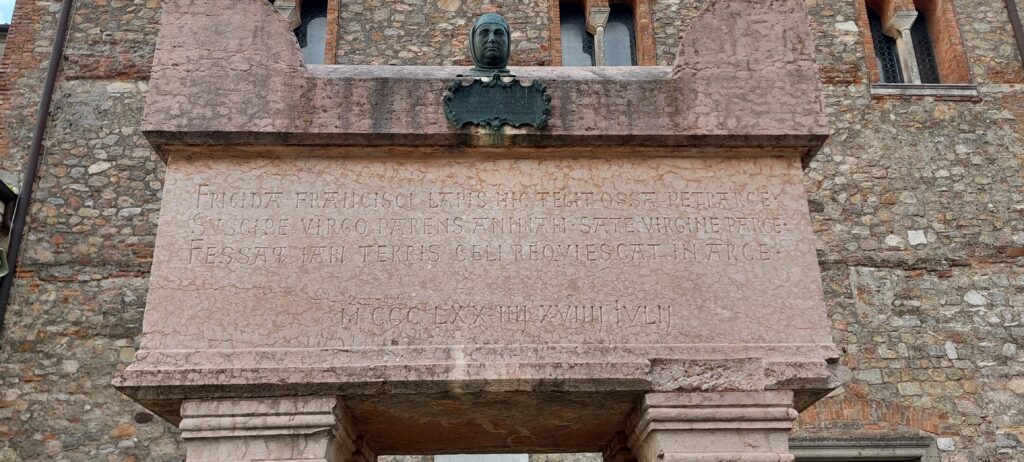
On the tomb is engraved an inscription that, according to Filippo Villani and other biographers, was dictated by the poet himself. It consists of three Latin hexameters — both a warning and a prayer — as was common on epitaphs of the time:
“Frigida Francisci lapis hic tegit ossa Petrace:
suscipe, Virgo parens, animam: sta, Virgo, parce,
fessa que iam terris coeli requiescat in arce.”
The paraphrase gives us words of profound intensity:
“This stone covers the cold bones of Francesco Petrarch:
Receive, O Virgin Mother, his soul; and you, Son of the Virgin,
have mercy: may it, weary of the earth, rest in the celestial fortress.”
On the upper step of the sarcophagus runs another inscription, honoring the poet and the family memory surrounding him:
“Viro insigni Francisco Petrarce laureato – Franciscolus de Brossano Mediolanensis gener individua conversatione amore propinquitate successione memoria.”
Which can be translated as:
“To the distinguished man Francesco Petrarch, poet laureate — Francesco da Brossano of Milan, his son-in-law, for their inseparable companionship, affection, kinship, succession, and eternal remembrance.”

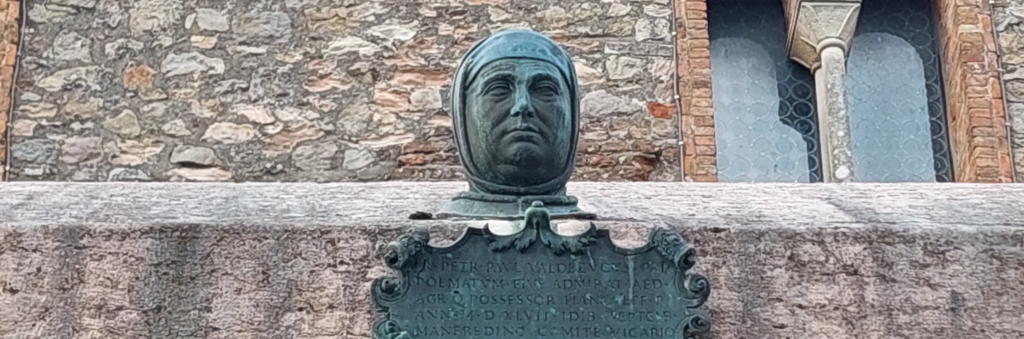
Atop the lid of the sarcophagus stands a bronze head of Petrarch, inspired by the famous portrait preserved in the Sala dei Giganti in Padua, where the poet’s face appears wrapped in a hood. This effigy was created and placed there in 1547 by Paolo Valdezocco, a nobleman from Padua and a great admirer of Petrarch’s works, who at the time owned the poet’s house and surrounding lands.
However, the head is a replica; the original is kept inside Petrarch’s house. The original piece bears the mark of a bullet hole and scratches from stones thrown by children of various eras who competed to strike it first.
Beneath the head, a bronze plaque bears a dedication, which reads today as follows:
“FR. PETR. Paulus Valdezucus Pat. Carnium eius admirator aedium agrorumque possessor hanc effigem posuit – ann. MDXLVII Idib. Septemb. – Manfredino Comite Vicario.”
“To Francesco Petrarch — Paolo Valdezocco of Padua, admirer of his poetry and owner of his house and fields — placed this effigy on September 13, 1547, when he was deputy to Count Manfredino.”
Even after death, Francesco Petrarch found no peace. His tomb became the focus of curious and unsettling events, testifying to how deeply he was admired — and contested.
In the fifteenth century, an artisan offered as much as 200 gold ducats to the church of Arquà on the condition that he be buried beside the poet. Fortunately, Bishop Jacopo Zeno rejected the request, deeming it a desecration.
In 1563, a proposal was made to build an Arcadian theater around the tomb “to honor Italy’s writers,” but the project was never realized.
The most famous and disturbing event occurred on the night of May 27, 1630. The parish seat was vacant following the death of the archpriest, and a young Lenten friar named Tommaso Martinelli from Portogruaro, with the help of the local dean and eight other townsmen armed with saws and chisels, attempted a true act of sacrilege: they forced open the western corner of the tomb and removed some of the poet’s bones.
Official documents record:
The chronicle recounts that the night was dark and stormy, and that, with great effort, they managed to extract the poet’s right arm. The friar and his accomplices escaped without capture. The next morning, the local vicar reported the incident to the municipality, ringing the church bell by hammer blows.
The Paduan authorities sent officers who inspected the tomb and confirmed the theft: the humerus, scapula, and several smaller bones were missing. Despite a lengthy investigation, the culprits were never caught, and the bones were never recovered. The tomb was eventually sealed with a safety slab to protect the poet’s remains.
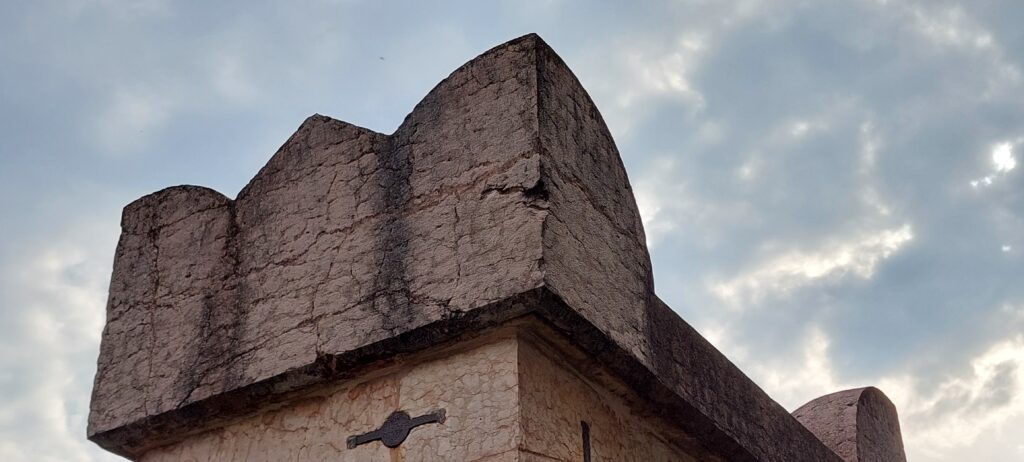
Two centuries later, Petrarch’s tomb was in poor condition and required restoration. Engineer Giuseppe Jappelli was called to carry out the work, which included:
- replacing the lower step with two pieces of Verona marble;
- creating a protective casing to safeguard the foundations;
- re-engraving the inscriptions with a chisel;
- polishing the entire monument with a grinding wheel, without altering its original state.
Initially, no one wanted to pay the 1,000 lire required, but the restoration was made possible thanks to Count Carlo Leoni. The tomb was opened on May 24, 1843, under the supervision of Gradenigo, who was in charge of the works.
Upon opening, the poet’s remains were found wrapped in a black tunic, with the skull facing west. Surprisingly, a hornets’ nest extended from the skull to the ribs. During its removal, a rib and a piece of the tunic detached and were given to Archpriest Saltarini.
Another fragment of the tunic, in 1873, was donated to the patriot Alberto Mario and, through inheritance, reached the Casa Carducci in Bologna, where it is still preserved today.
The restoration, however, was not without controversy: the inscriptions were judged too wide, Count Leoni had acted without a license — risking prosecution — and some retouches were deemed excessive. Moreover, the removals were not well received by the local population. The relics were therefore returned to the tomb, together with a copper cylinder containing the fifth copy of the official report drafted during the restoration.
The last opening of Francesco Petrarch’s tomb took place on December 6, 1873, this time under the direction of Giovanni Canestrini, professor of comparative anatomy at the University of Padua. The scholar conducted a detailed anthropological examination of the remains.
Unlike previous openings, the skeleton appeared deteriorated, and contact of the skull with air caused it to crumble. The analysis revealed that Petrarch had a dolichocephalic skull, with a low, broad face, a forehead not very high and slightly receding. The right femur was about one centimeter shorter than the left and slightly curved inward. It was concluded that the poet had been muscular and robust, with an estimated height between 183 and 184 centimeters.
The bones were brownish in color, and the hair reddish — though this hue was believed to result from contact with the surface on which the body had rested. In fact, it is known that in his youth Petrarch’s hair was pure white.
Fortunately, not all the bones had been stolen, and the remains were placed in a firwood box. However, even then a theft occurred, attributed to Abbot Piombin, who later returned the stolen items.
Also missing was a distich once engraved on the tomb, which read:
“INVENI REQUIEM: SPES ET FORTUNA VALETE: NIL MIHI VOBISCUM EST: LUDITE NUNC ALIOS”
Translated:
“I have found rest: farewell hopes and fortune — I have nothing more to do with you; go now, deceive others.”
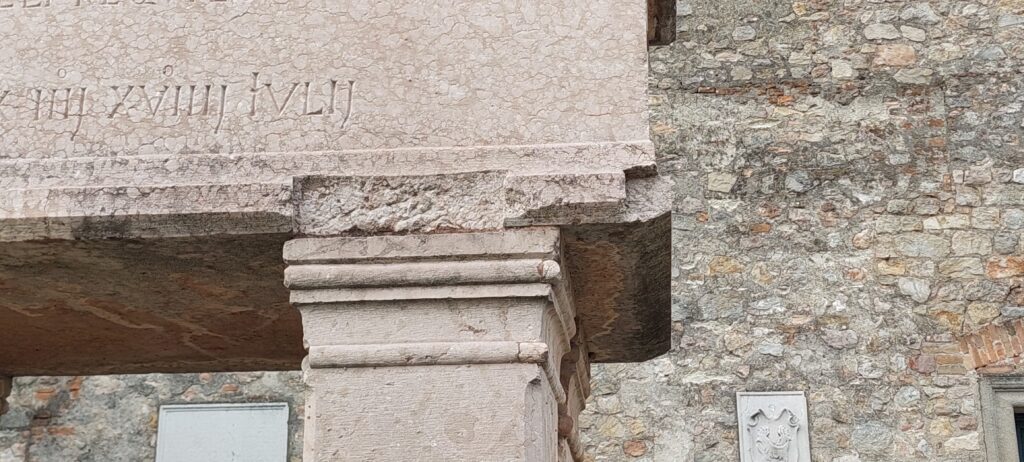
Over the centuries, Petrarch’s tomb also suffered minor but constant damage. It is said that a cobbler once scraped fragments from the monument’s surface to sell them to visitors as souvenirs.
These incidents, together with ongoing depredations and the curiosity of collectors, prompted the authorities to intervene. In 1928, the Municipality of Padua decided to install a protective railing, finally safeguarding the sarcophagus from further theft or damage.
The most recent restoration took place in mid-2025, during which the tomb underwent a thorough cleaning that restored its original brightness.
GO BACK TO THE WEBSITE HOME PAGE
DESCRIPTION: