GO BACK TO THE WEBSITE HOME PAGE
THE ORATORY
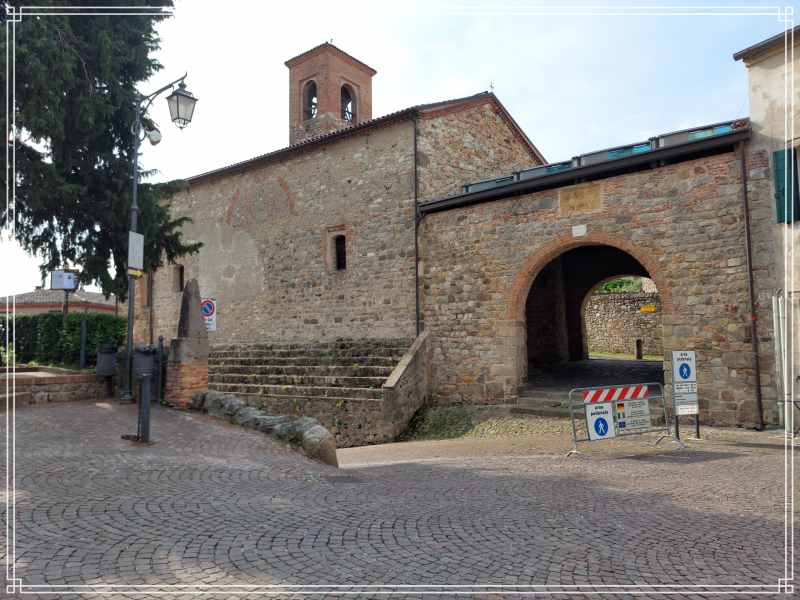
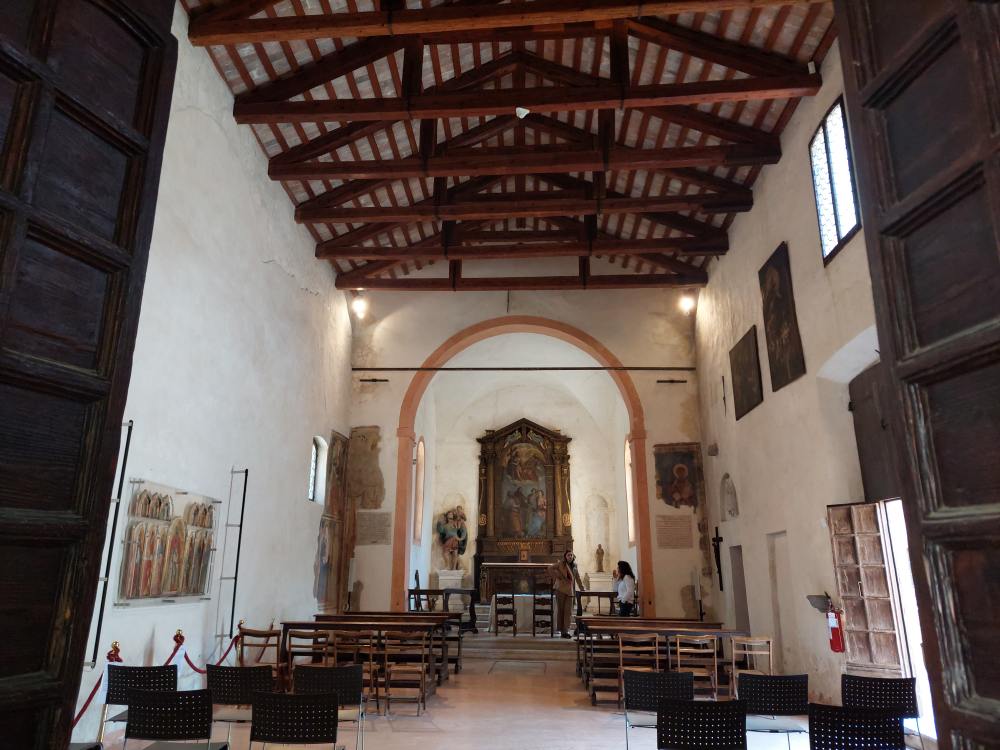
The oratory is now deconsecrated, but it is still used on certain special occasions, such as for the celebration of civil weddings.
In past centuries, this church played a very important role for the inhabitants of the upper part of the village. The climb was indeed tiring, and in 1623 the Vicariate and several noble families who lived in that area — such as the Zabarella, Borromeo, and Beslevere — decided to pay a priest to celebrate Mass.
The first historical mention of this church dates back as far as July 7, 1181, when it was cited in a document as “Sanctae Trinitatis.” On that occasion, the priests of Arquà granted the use of a wooded plot on the hill of Ventolone.
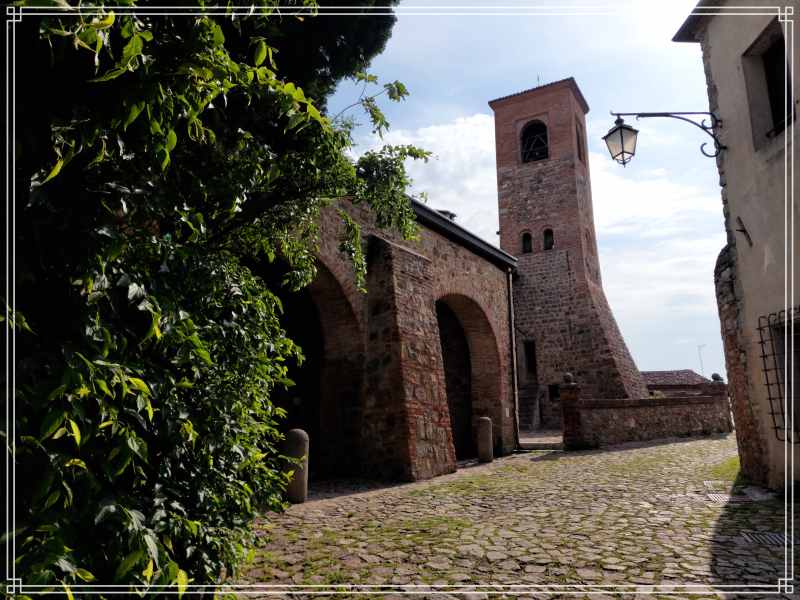
The building was enlarged several times: a first expansion probably took place in the 14th century, while in the 15th century the apse was added — the semicircular section still recognizable today. The external bricks reveal this phase: along the nave the cornice is dentil-shaped, while around the apse it is smooth.
Inside, the walls were once covered with frescoes. Unfortunately, around 1600, an earthquake caused serious damage, and during restoration many paintings were covered with a layer of white lime.
The masonry structure also shows some peculiarities. From a report dated August 18, 1847, we know that there was a plan to reinforce the northern wall with a barbacane, a kind of stepped buttress. However, due to the tuffaceous nature of the rock, another solution was chosen: the underlying rock was demolished for about seven meters, until it reached the level of the road.
The original floor of the nave was about fifteen centimeters lower than the one we see today, which is in Venetian style.
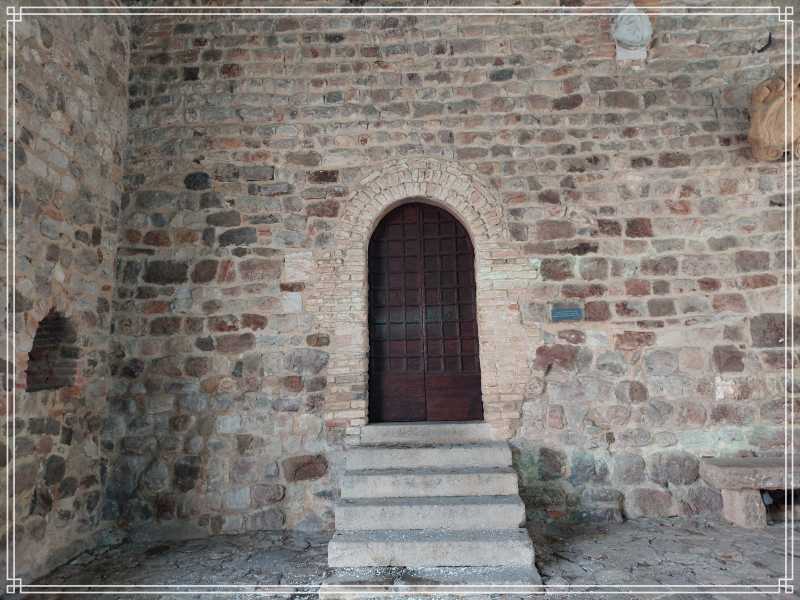
In the past, the church was directly connected to the Loggia dei Vicari through a small full-arched doorway, used on hearing days. Later it was walled up, but in 1920, during restoration work, it was reopened and fitted with steps.
Finally, to the right of the oratory lies the churchyard, which in the past was occasionally used as a burial site.
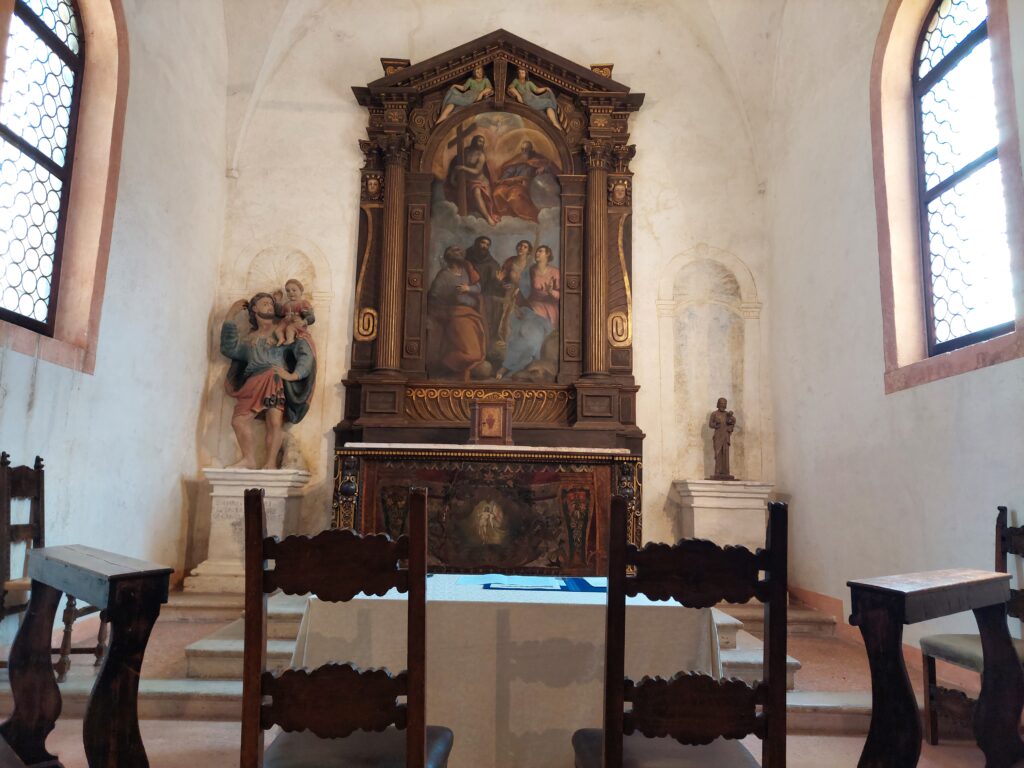
Inside the oratory there is a single altar, made of carved and painted wood, with gilded decorations that enhance its details.
The large altarpiece — about 2.77 by 1.29 meters — depicts the Holy Trinity, with the Father, the Son, and the Holy Spirit, accompanied by Saints Joseph, Francis, Lucy, and Margaret. The work bears the signature “Jacobus Palma” and the date 1626, and it belongs to Palma il Giovane, who painted it in his old age, at 82 years.
The style, in fact, appears rather weak and sweetened — the mark of an artist nearing the end of his creative path.
Saints Joseph and Margaret were included as a tribute to the patrons of the work, who bore those same names. At the bottom, in the center of the wooden frame, a carved daisy can be seen — another homage to Lady Margherita.
The paliotto of the altar dates back to the 18th century. It is made of painted leather and depicts the Risen Christ in the center, surrounded by floral garlands. The execution is quite simple, but very charming.
The figure of Saint Christopher appears twice inside the oratory. This saint, known for helping the Child Jesus cross a river and for being the protector of pilgrims, is portrayed as a giant. The most prominent representation is to the left of the altar: a colored statue in soft stone, placed on a pedestal with a Latin inscription commemorating a restoration carried out in 1767.
The second representation is less visible but still imposing. It is found on the left wall, before the staircase leading to the altar, although it has not survived in perfect condition.
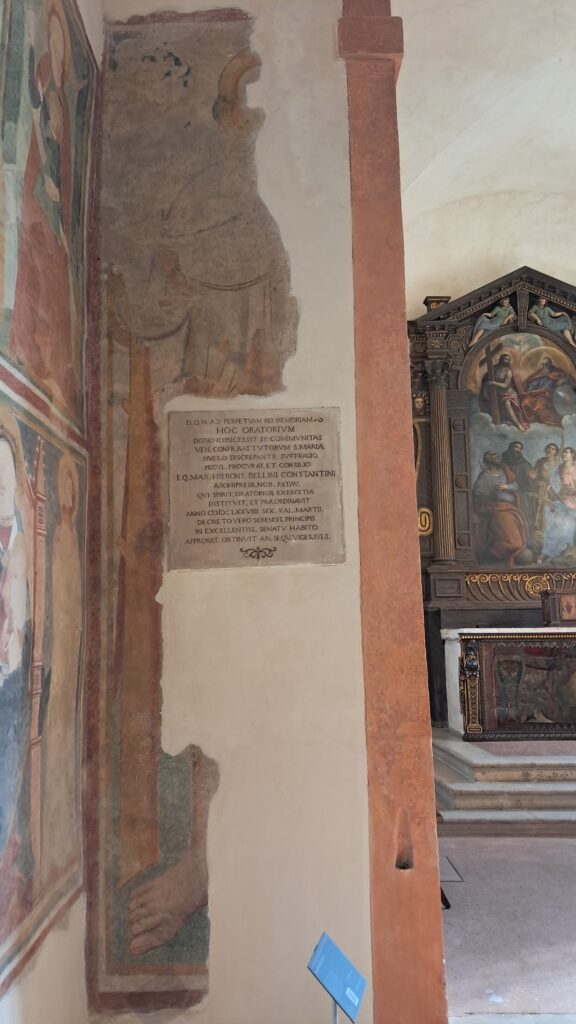
Finally, by observing the walls carefully, one can notice several tombstones embedded in the masonry — evidence of the long history of this sacred place.
One on the north wall reads:
Qui giace zuane zara il qual do
tò.
questa chiesa
di lire quaranta
a. l’ano con obrigo.
di celebrare
messe sei a l’ano
in perpetuo.
L’ano 1646. f. d.
Paraphrased:
Here lies Zuane (Giovanni in Venetian), who donated forty lire per year to this church, with the obligation to celebrate six Masses each year in perpetuity. Year 1646.
Obligations long since fallen into disuse.
Another inscription preserved inside the oratory contains a brief elegy — an epigram written out of affection and remembrance. It was composed by Arsenio Merio, a member of the College of Jurisconsults of Padua.
The text recalls the tragic death of a young man of only twenty, Bernardo, treacherously murdered in August 1610.
Ecclesiae aicet hic Bernardus gloria gentius,
virtute eximius, nobilitate micans.
Quattour ipse suae volvebat lustra iuventae:
proh, dolor! En nobis morti violenta tulit.
Foedus amicitiae ficti fregere sodales,
praedones novit, quos fecerat socios.
Prodere cum cuperent miserium per nemora ducunt;
ore pacem simulant, corde venea tegunt.
Concidit extremo telis confixus iniquis,
sub pedibusque fuit nomen amicitiae.
Translation:
In this place of the church lies Bernardo,
glory of his people, of distinguished virtue and nobility. He was in his fourth decade of youth
when, alas, a violent death took him from us.
False friends broke the bond of friendship;
those he had trusted turned out to be robbers.
Yearning to betray him, they led the poor soul through the woods;
they spoke of peace with their lips, while hiding poison in their hearts.
At last he fell, pierced by unjust weapons,
and the name of friendship lay trampled underfoot.
Another plaque on the left wall states that the oratory was unanimously granted by the Municipality to the Confraternity of St. Mary of the Battuti, which established its practices there in 1679:
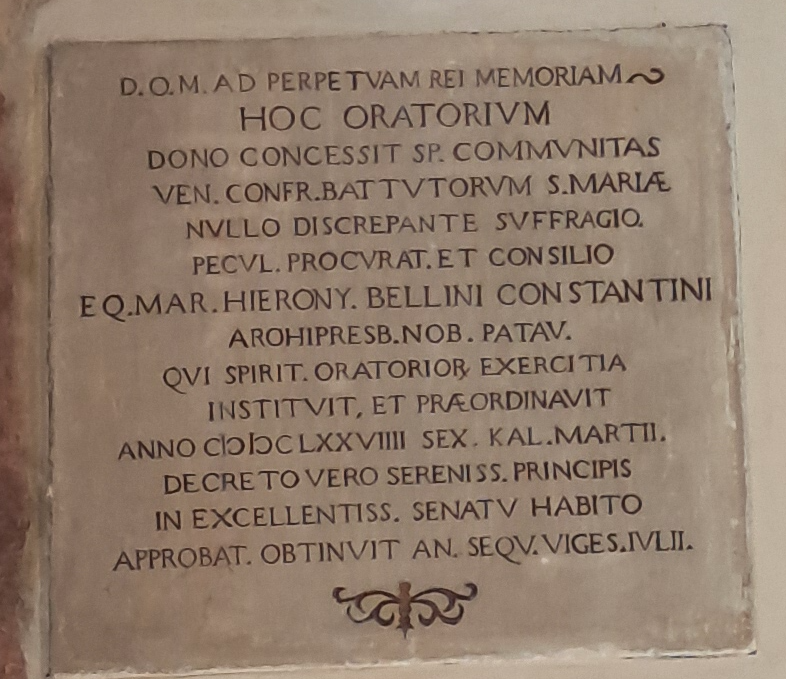
D.o.m. Ad perpetvam rei memoriam hoc orarorivm
dono concessit sp. commvnitatis ven. confr. Battvtorvm s. Mariae
Paraphrased:
“To God, most good and great. To the perpetual memory of this event, this oratory was donated by the spiritual community to the Venerable Confraternity of St. Mary of the Battuti.”
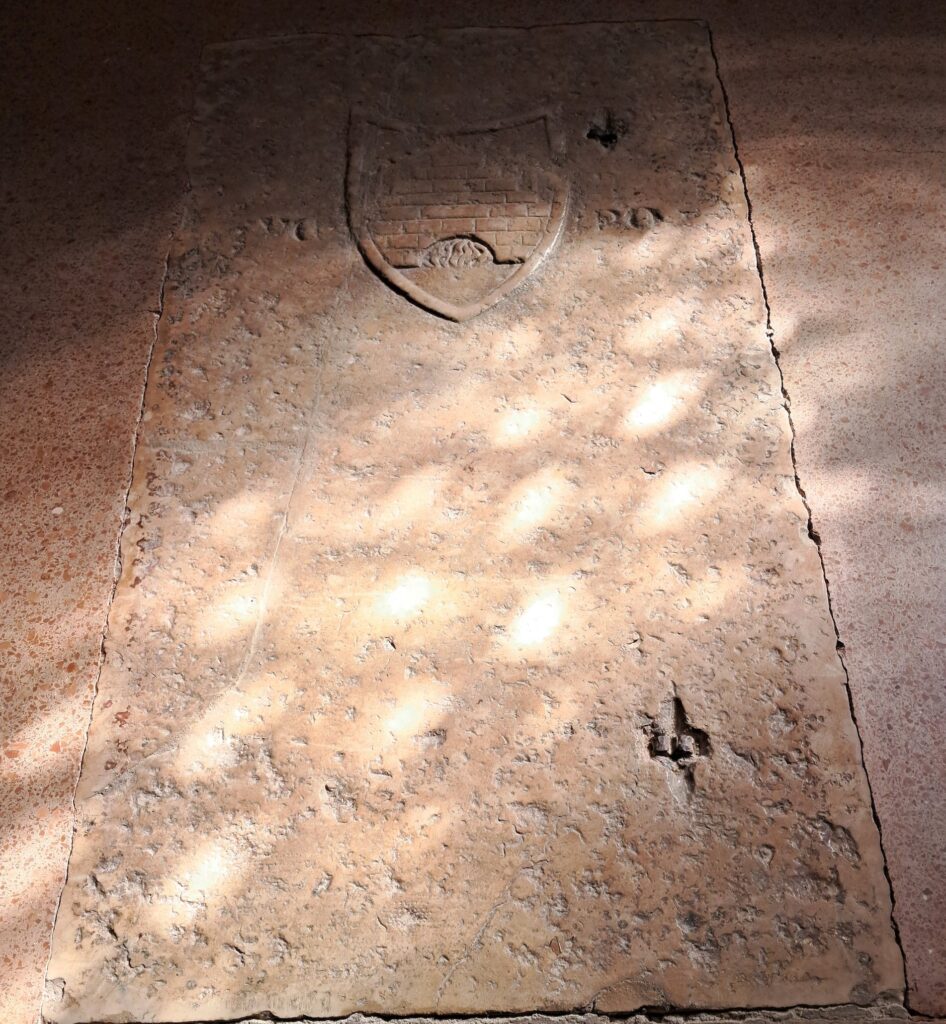
In the presbytery are two ancient tombstones set into the floor.
The first bears the coat of arms of the Da Ponte family, accompanied by the letters “VE PO.” It refers to Marco Da Ponte, who in the 15th century purchased the gastaldia of Arquà for 24,000 lire.
The second stone belongs to the noble Paduan family of the Conti, dating from the 14th century, who owned numerous properties in Arquà.
Continuing toward the nave, directly opposite the entrance to the presbytery, another burial slab can be seen. It bears the coat of arms of the Zabarella family and a Latin inscription:
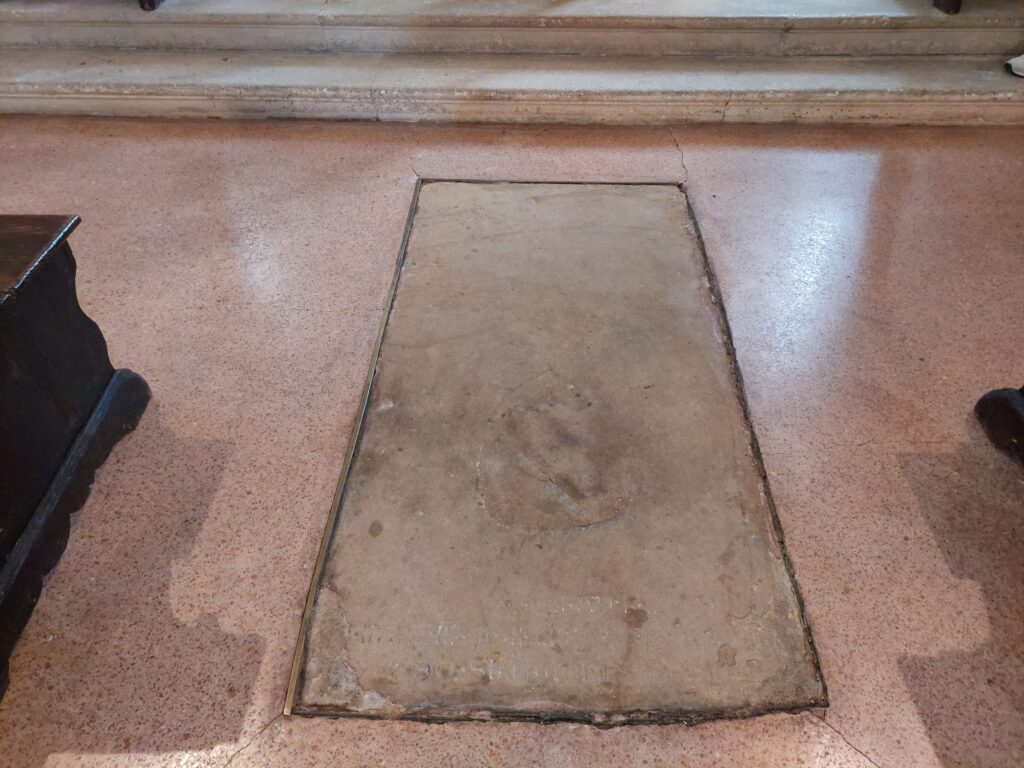
“HIC SITVS EST JOPNATES DE SABARELLIS QVI OBIIT AN MCCCCXXXII, XXVI IVLII ARQVADE.”
Translated: “Here lies Giopnates de Sabarellis, who died in the year 1432, on July 26, in Arquà.”
On the southern wall there is a precious painted polyptych on a gold background, depicting: in the center, Saint Augustine with two angels placing the miter upon him; to the left, Saints Paul, Gregory, and Bernard; to the right, Saints John the Baptist, Jerome, and Ambrose.
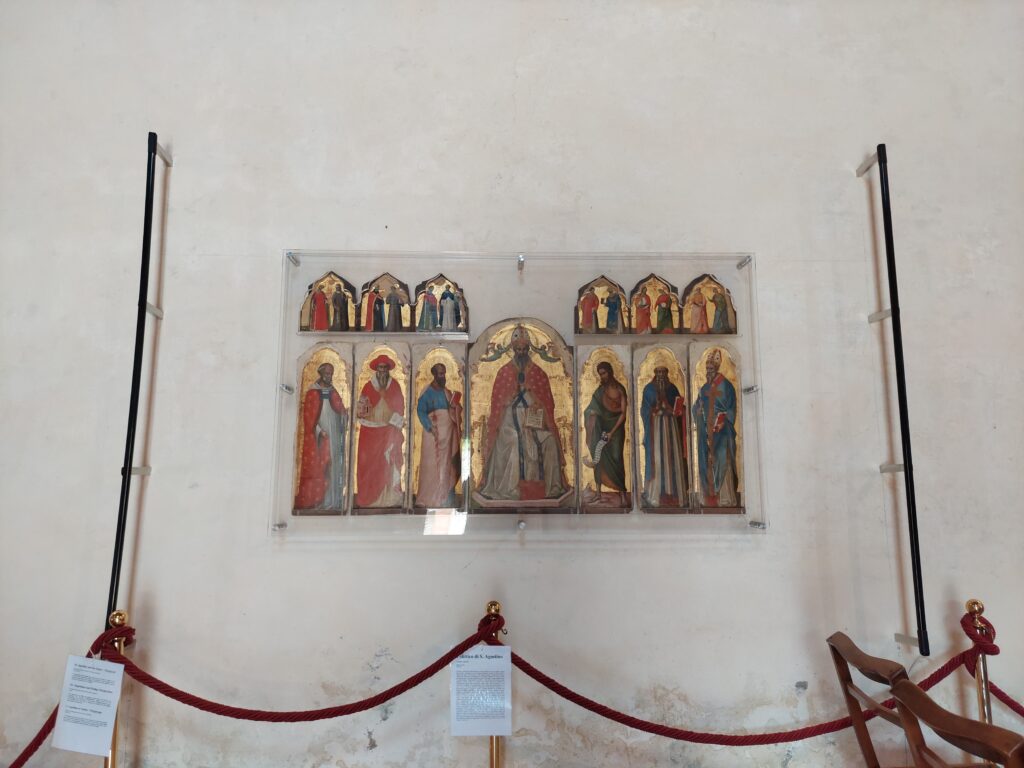
In the six upper panels, pairs of saints.
It is attributed to Lorenzo Veneziano — certainly of the Venetian school of the second half of the 14th century.
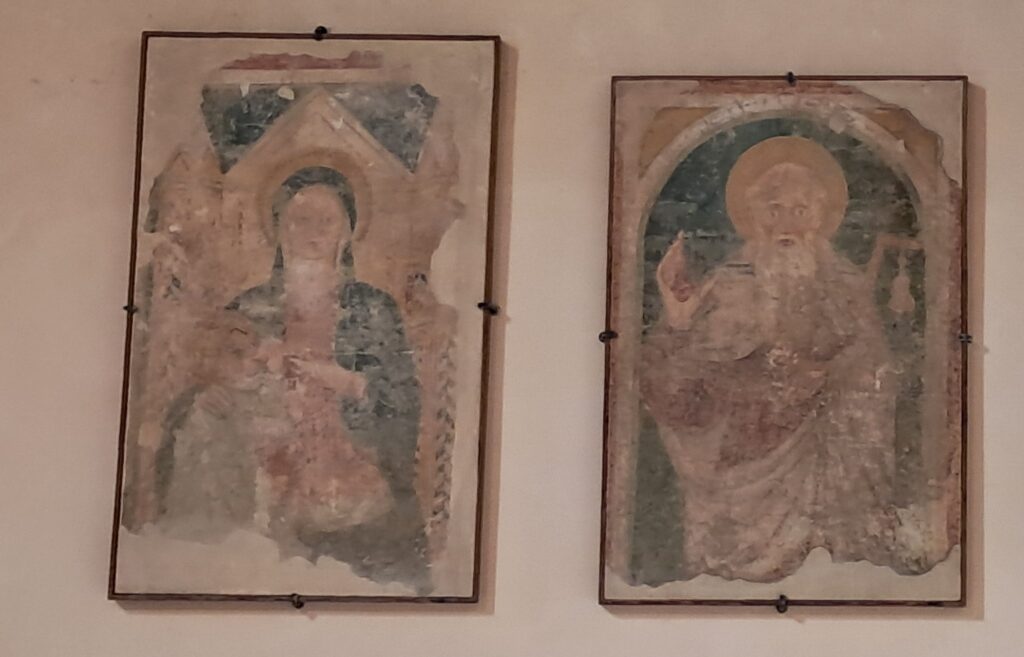
There are also two paintings that were originally outside, in the loggia, but were later removed and brought inside for preservation. The painting on the left depicts a Madonna nursing the Child, while the one on the right shows Saint Anthony Abbot holding a flame in his palm — the “fire of Saint Anthony.”
Saint Anthony, during a pilgrimage, was struck by the disease once believed to be the devil tormenting him; from this, he became the patron saint protecting against that illness.
Opposite the altar is a large painting depicting the transfer of authority between Antonio degli Oddi and his successor and relative, Daniele.
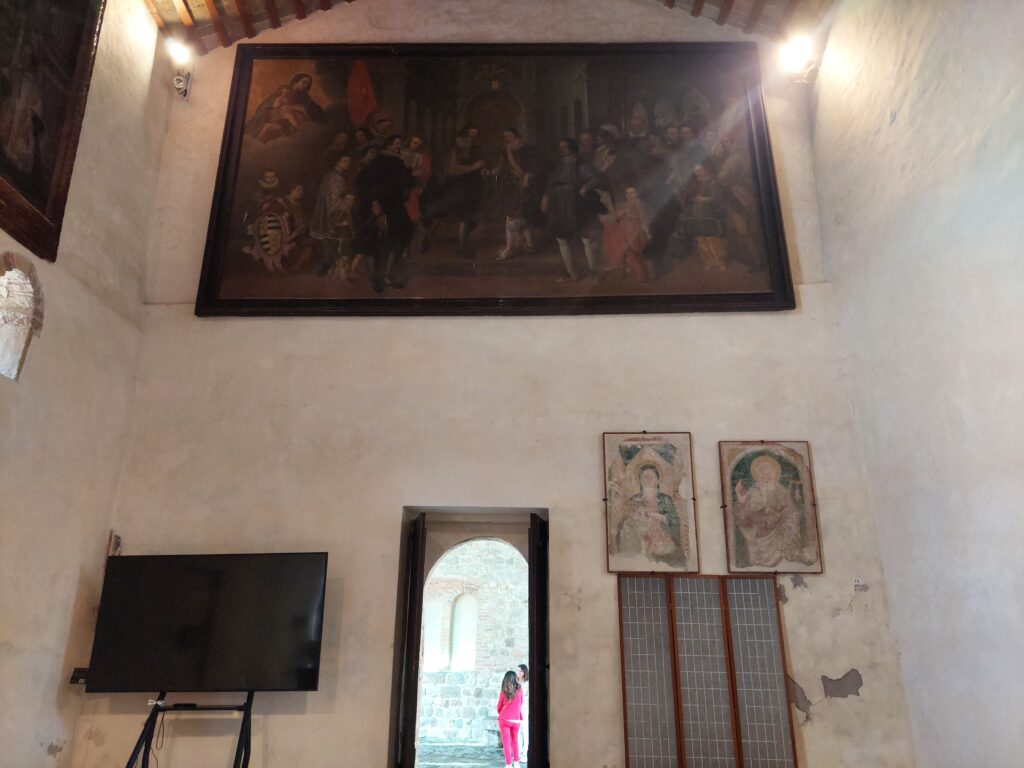
The scene unfolds within grand architecture. Around the main figures are family members and several commanders and officials of the Vicariate, recognizable by their red headgear with a yellow rosette. They carry a scarlet banner with the Lion of Saint Mark clawing the coat of arms of Padua over a passage from the Gospel. Nearby can be seen a bundle of candles and a rolled Turkish carpet — symbols of prestige and solemnity.
Also present is the town trumpeter, making the ceremony even more official.
At the top left appears the Virgin and Child, while below is the coat of arms of the Oddi family, emphasizing the transfer of Vicariate authority between the two cousins, shown at the center of the painting.
On one of the steps, the inscription reads:
Daniel de oddis ab antonio eiusdem famile viro
iurisdictions onus accipt
et hoc affectus sui monum. p.a.
Paraphrased:
“Daniele de Oddis, from Antonio, a man of the same family, assumes the burden of jurisdiction and [sets up] this monument out of affection.”
To the left:
io. baptista de pelizaris ver f
MDCXXIII
Paraphrased:
“Giovanni Battista de Pelizaris had it made. 1623.”
Another large painting, enclosed in a richly decorated carved frame, dates from 1670 and is the work of an anonymous artist.
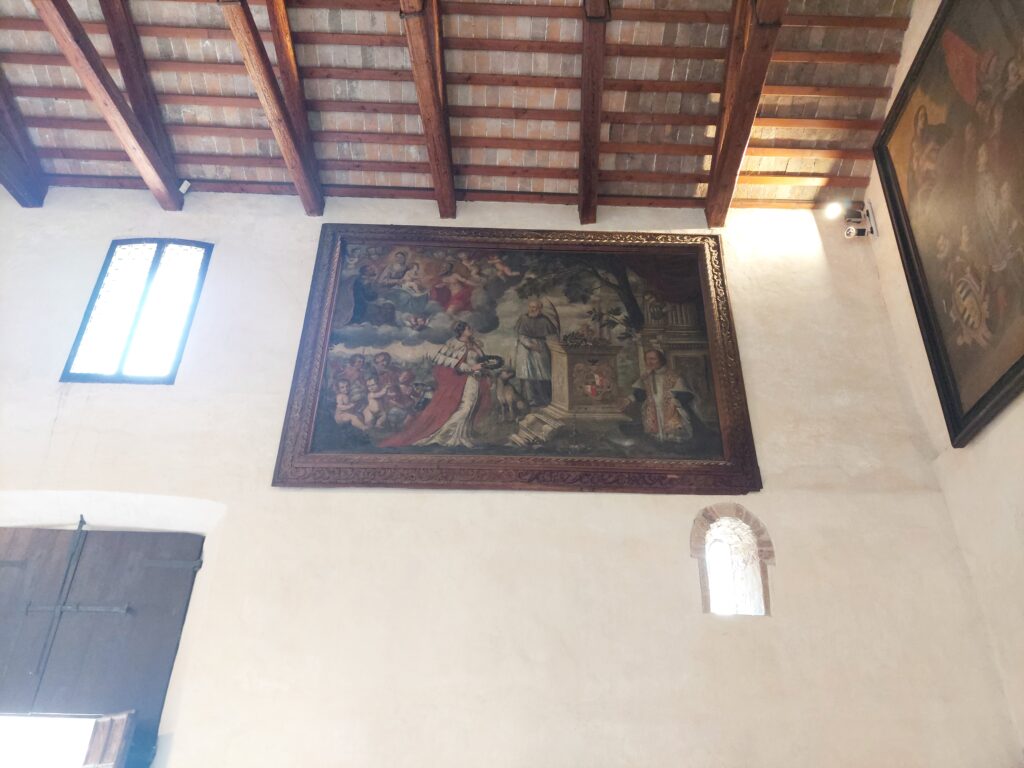
The scene represents Padua in allegorical form: a woman wrapped in a royal mantle, traditionally called by the locals “Queen Berta.” In her hands she holds a laurel crown, followed by cherubs carrying various symbols — a royal crown, a tiara, a globe, a book, the serapic serpent, and armor bearing the Venetian Lion in moleca, meaning in frontal position.
Padua advances, following the invitation of a martyred bishop, toward the altar before which the donor — the painting’s commissioner — kneels, having chosen to be depicted within the work.
In the clouds above appears the Madonna in glory, flanked by Saints Mark and Jerome, the two saints whom, because of their names, the devout patron regarded as his protectors.
In the background, the Basilica of Padua can be recognized, placing the scene in the heart of the city.
It is believed that this painting was originally kept in the parish church and was moved here to make space for the new organ built by the famous Callido, a master organ builder of the 17th century.
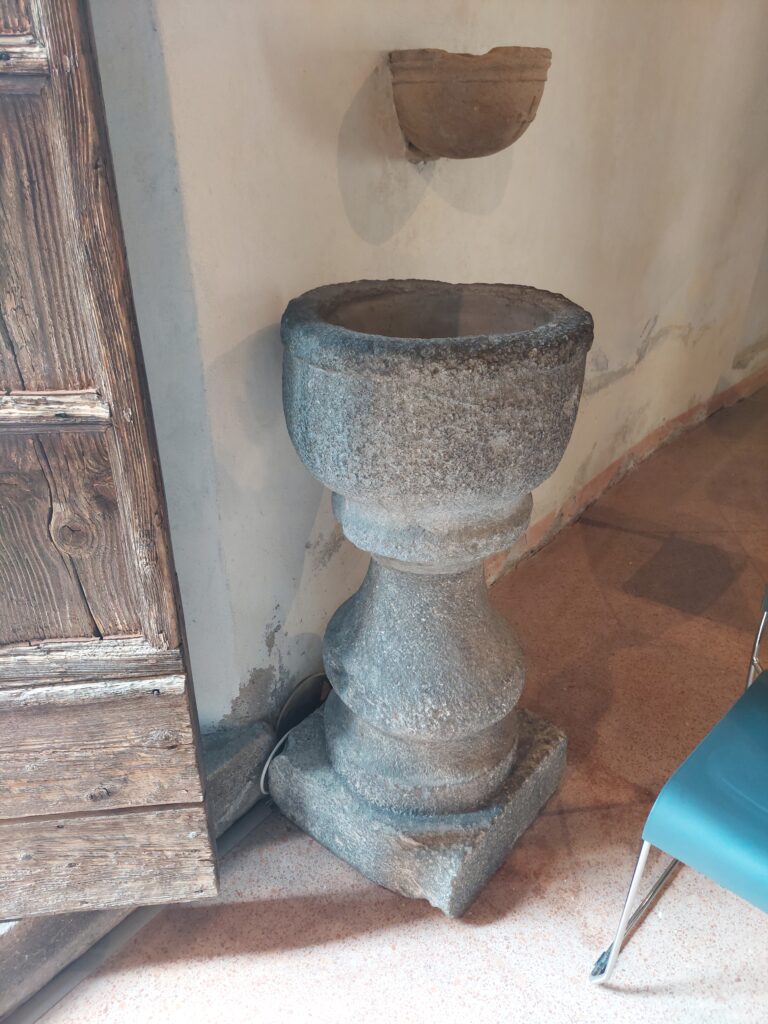
Near the side entrance of the church, one can see the holy water stoup, which, according to tradition, is nothing other than a cinerary urn from pre-Roman times. Its lid is now preserved in the Museum of Este.
There is also a final inscription, placed in 1960, commemorating the restoration of the time and the visit of the Pontiff:
Questo oratorio
ove si raccolse a pregare Francesco Petrarca
ove giunse pienamente nel MCMLV il futuro pontefice Giovanni tredicesimo
fu restaurato alla pietà dei fedeli nell’anno del signore MCMLX
dalla sovrintendenza ai monumenti con il generoso contribuito dello Stato della Provincia del Comune
per volontà di popolo l’arciprete D.A. Gardin P.
This oratory,
where Francesco Petrarch gathered in prayer,
where in MCMLV the future Pontiff John XIII arrived,
was restored for the devotion of the faithful in the Year of Our Lord MCMLX
by the Superintendency of Monuments, with the generous contribution of the State, the Province, and the Municipality,
by the will of the people.
The Archpriest D.A. Gardin P.
The Bell Tower
The oratory’s bell tower is a very ancient structure. A document from 1580 mentions the presence of a clock.
In 1847, the belfry was rebuilt, as it had become unsafe. The work was entrusted to Engineer Maschietti of Monselice. On that occasion, to correct what was considered a “stylistic awkwardness,” the lowered-arch windows were transformed into pointed openings, and Ghibelline- style battlements were added at the top. At the same time, the mullioned windows of the lower part of the square tower were sealed.
In 1928, the bell tower was again at risk of partial collapse. It was therefore decided to restore it to its original appearance, following Maschietti’s designs, confirmed also by old 17th- and 19th- century prints. During this restoration, the battlements were removed, and the four-sided roof was reinstated, as it had been in the past.
In the lower part of the bell tower, there is a small room that once served — and still serves — as the sacristy.