GO BACK TO THE WEBSITE HOME PAGE
DESCRIPTION:
In 1369, Francesco Petrarca, by then elderly, ill, and weary, decided to settle in Arquà, accompanied by his daughter Francesca, his son-in-law Francescuolo da Brossano, and his granddaughter Eletta. Here he spent the final years of his life, until his death on the night between October 18 and 19, 1374.
It is believed that the house was donated to the poet by Francesco il Vecchio da Carrara, lord of Padua and friend of Petrarca. The poet personally oversaw the renovation work, combining two buildings located on different levels into a single complex suited to his needs.
The right side of the building was reserved for the servants, while the left side was the main residence, intended for the poet’s family. In front of the house there was a garden, and behind it extended an orchard.
Petrarca also modified the internal layout of the rooms. The central room of the main section became a reception and connecting hall, illuminated by a large window facing the garden and completed with a fireplace on the orchard side, making it functional for both daily life and receiving guests.
THE ENTRANCE
The entrance to Petrarca’s house today allows access much as in the poet’s time, although originally one could freely walk up from the public road to the garden.

When the Municipality of Padua became the owner, a new straight access path was created and remained in use until 1923. That year, the entrance was closed and restored to its original path, with the addition of a gate for safety reasons.
The boundary wall features a door with a pointed arch, decorated with a brick frame of small square tiles, each carved in a diamond pattern.
To the left of the entrance, an iron ring can still be seen — once used to tie horses.
The front garden of Petrarca’s house was adorned with a grapevine pergola and probably with a small herb garden, as was the poet’s custom: rosemary, hyssop, and horehound.
In the 15th century, the patrician Girolamo Donato mentioned in a Latin poem a laurel tree planted by Petrarca himself:
“Hic doctis laurus manibus plantata Petrarchae est”
(“Here is the laurel planted by Petrarch’s learned hands.”)
The same tree is also mentioned by the chronicler Sanudo in 1483, testifying to the longevity and prestige of the plants cared for by the poet.
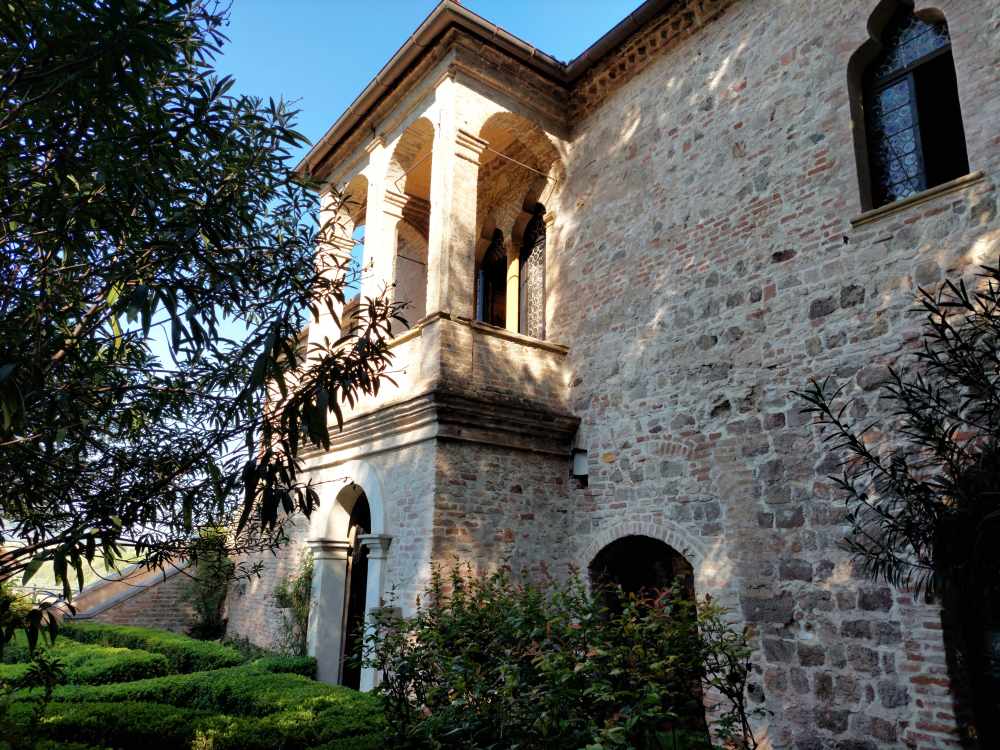
Later, Paolo Valdezocco built a charming Renaissance-style loggia and the external staircase, while the Cassici family modified the windows to make them square, allowing more light inside, and closed the triple lancet window — a change that aroused the protests of Gabrielli and led to a lawsuit; the original interrogations are preserved at the Civic Museum of Padua.
Although added after Petrarca’s death, the loggia was preserved during later restorations and remains today one of the most distinctive and recognizable features of the house.
The idea of transforming the building into a museum was proposed by the abbot Stefano Piombin of Monselice, who inaugurated it on July 18, 1878, with a speech accompanied by Andrea Gloria, thus opening the poet’s home to the public.
VISIT TO THE FIRST FLOOR:
1) CENTRAL ROOM OR ROOM OF THE METAMORPHOSES
Between 1546 and 1556, when the house belonged to Paolo Valdezocco, the walls of the main rooms were decorated with frescoes inspired by Petrarca’s works.
The fresco scenes unfold in the upper parts of the walls, while in the lower portions traces of 14th- century decoration remain, still partly visible in the poet’s study, bearing witness to the historical and artistic layering of the building.
The frescoes are attributable to at least two different artists, whose names have not survived.
The visual sequence begins at the far left corner of the wall and proceeds counterclockwise, guiding visitors through a pictorial journey that retraces the poet’s stories and works.
1A) Laura and Love transform the poet into a laurel tree:

[…] “facendomi d’uom vivo un lauro verde, che per fredda stagion foglia non perde”
“[…]turning me from a living man into a green laurel, whose leaves no cold season makes fall.”
In the next painting:
1B) The poet is transformed into a swan:
(original Italian text) “ond’io presi col suon color d’un cigno”
“so that with my song I took on the hue of a swan.”

1C) Laura and Petrarca are shown in three different scenes:
Laura tears the poet’s heart from his chest.
(original Italian text)“questa che col mirar gli animi fura, m’aperse il petto e ‘l cor prese con mano”
“This woman who steals souls with her gaze opened my chest and took my heart in her hand.”

The poet meets Laura again but does not recognize her.
(original Italian text) “poi la rividi in altro habito sola tal ch’ì non la conobbi, oh senso umano”
“Then I saw her again, alone, in another form, so that I knew her not — oh, human sense!”
Laura transforms the poet into stone.
(original Italian text) “tosto tornando, fecemi, oimè lasso, d’un quasi vivo et sbigottito sasso”
“Returning soon, alas, she turned me into a nearly living, astonished stone.”
Continuing counterclockwise on the right-hand wall.
1D) The poet lies down on the grass and, weeping greatly, turns into a spring:

“As one who sleeps between travelers, weary, I lay down on the grass one day. There, blaming the fleeing sunbeam, I loosened the reins of my tears and let them fall as they would; nor did snow beneath the sun disappear faster than I felt myself dissolve, becoming a spring at the foot of a beech.”
In the next depiction, two scenes are shown.
1E) The poet meets Laura again,
and Laura turns Petrarca once more into stone:

(original Italian text) “Ma nulla à ‘l mondo in ch’uomo saggio si fide: ch’ancor poi ripregando, i nervi et l’ossa mi volse in dura selce; et così scossa voce rimasi de l’antiche some chiamando Morte, et lei sola per nome”
“But nothing in this world can the wise man trust; for praying once again, she turned my nerves and bones into hard flint; and so, stripped of my ancient burdens, I remained a voice calling Death alone by name.”
In the second-to-last one, two scenes are depicted again:
1F) The poet comes upon Laura naked in a spring:

(original Italian text) “ch’un dì cacciando sì com’io solea mi mossi; e quella fera bella et cruda in una fonte ignuda si stava, quando ‘l sol più forte ardea. Io, perché d’altra vista non m’appago, stetti a mirarla: ond’ella ebbe vergogna; et per farne vendetta, o per celarse, l’acqua nel viso con le mani mi sparse”
“One day, hunting as I was wont, I came upon that fair and cruel beast, who stood naked in a fountain when the sun burned most fiercely. I, content with no other sight, gazed at her; she blushed, and, to avenge herself or hide, splashed water in my face with her hands.”
The poet turns into a deer and flees, pursued by hounds:
(original Italian text) “Et in un cervo solitario et vago di selva in selva ratto mi trasformo: et anchor de’ miei can’ fuggo lo stormo”
“And swiftly I was changed into a solitary, wandering stag, from wood to wood I fled — and even my own hounds I shunned.”
1G) The frescoes end with the figure of the eagle, with which the poet identifies himself:
(original Italian text) “et fui l’uccel che più per l’aere poggia, alzando lei che ne’ miei detti honoro”
“And I became the bird that soars highest through the air, lifting up the one whom in my verses I honor.”

1H) Beside the eagle, an altar with an eternal flame appears,
(original Italian text) “nec vento nec imbre” (“neither wind nor rain can extinguish it”).
Among the decorative details of the room stands a five-pointed star, symbol of well-being — or perhaps of an unbreakable knot — a typical element of Renaissance symbolism.


The modifications made by Paolo Valdezocco aimed to celebrate the house as a shrine of memories linked to Petrarca, but they also sparked criticism among contemporaries, not always in agreement with his taste or approach.
Thus, Sperone Speroni (Padua, 1500–1588), who worked to save Petrarca’s house in Padua from demolition, wrote:
“Changing his room from its original state with decorations is blameworthy… one should have preserved it in its antiquity, not only the room itself but even the plaster and dust of his time, if possible.”
In modern Italian, this would sound like:
“Modifying the room by adding decorations is something to be condemned… everything should have been preserved as it was originally, not only the room itself, but even the plaster and the dust of his time, which, if possible, should have been preserved.”
2) THE ROOM OF VENUS
This room may originally have been Petrarca’s bedroom. The friezes along the upper part of the walls are now in a rather poor state of preservation.
According to early descriptions from one of the first guides to the house, published in 1623 by Ercole Giovanni “Il Petrarchista”, the decorations refer to the Petrarchan song “Qual più diversa et nova” (no. 135 of the Canzoniere), which recounts extraordinary natural phenomena.
Among the frescoed details, one can notice a ship, possibly representing the vessel sailing on the “Indico mar” (“Indian sea”), as narrated in the poem — recalling the legend of the magnet stone that attracts iron.

Another scene depicts a well or spring beside two male figures: this is the Spring of Epirus, famous for its miraculous property — when a lit torch is dipped in it, it goes out; when an unlit one is dipped, it catches fire.

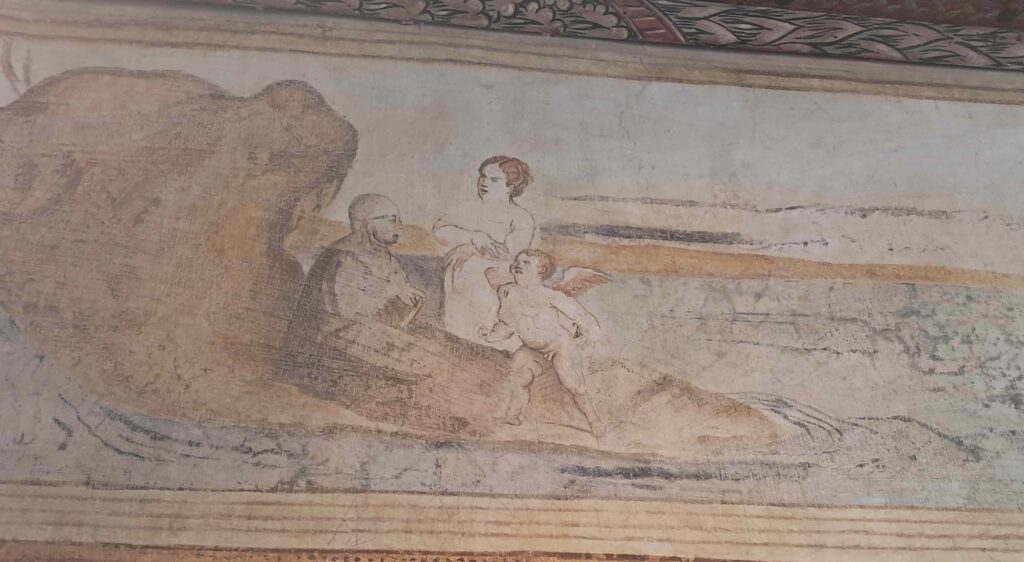
On the right wall, Petrarca is shown seated beside a spring, book in hand, facing a woman with a child.
The paintings on the fireplace are well preserved:
depicting the god Vulcan with his wife Venus and the god of love, Cupid.

On the left wall, a woman is shown trapped in a net, watched by a male figure — likely a simplified version of the myth of Vulcan capturing the lovers Venus and Mars and exposing them to the mockery of the other gods.

The “Venus and Mars” scene tells a famous ancient myth: the goddess of love, Venus, fell in love with Mars, the god of war, though she was already married to Vulcan, the blacksmith god. Their secret affair was discovered by the Sun god, who warned Vulcan. Vulcan then forged a fine magical net and captured the two lovers, displaying them imprisoned before all the gods of Olympus.
On the stone lintel of the fireplace, a long inscription remains, left by Austrian students in 1544 to mark their visit to the poet’s house.

To prevent visitors from continuing to write their names or inscriptions on the house’s walls, the so- called “Codici di Arquà” (“Arquà Registers”) were introduced in 1787 — paper volumes where anyone could record their visit.
Until 1970, this room was known as the “cat room”, due to the embalmed remains of a cat placed above the door; the remains were later moved to the ground floor.
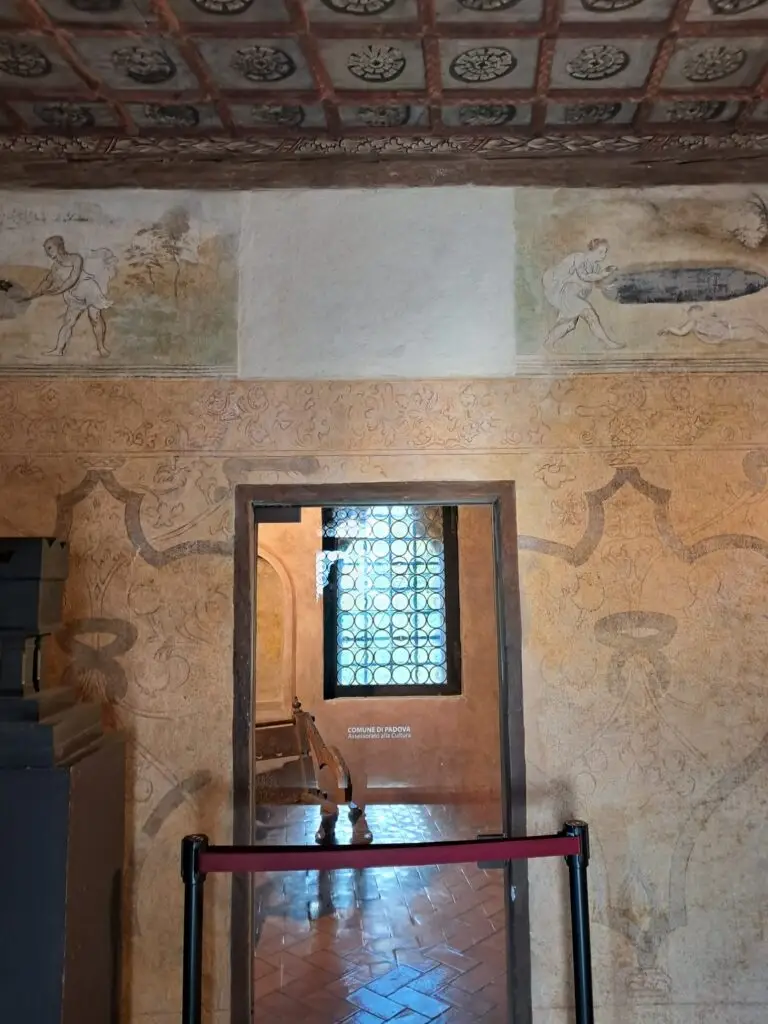
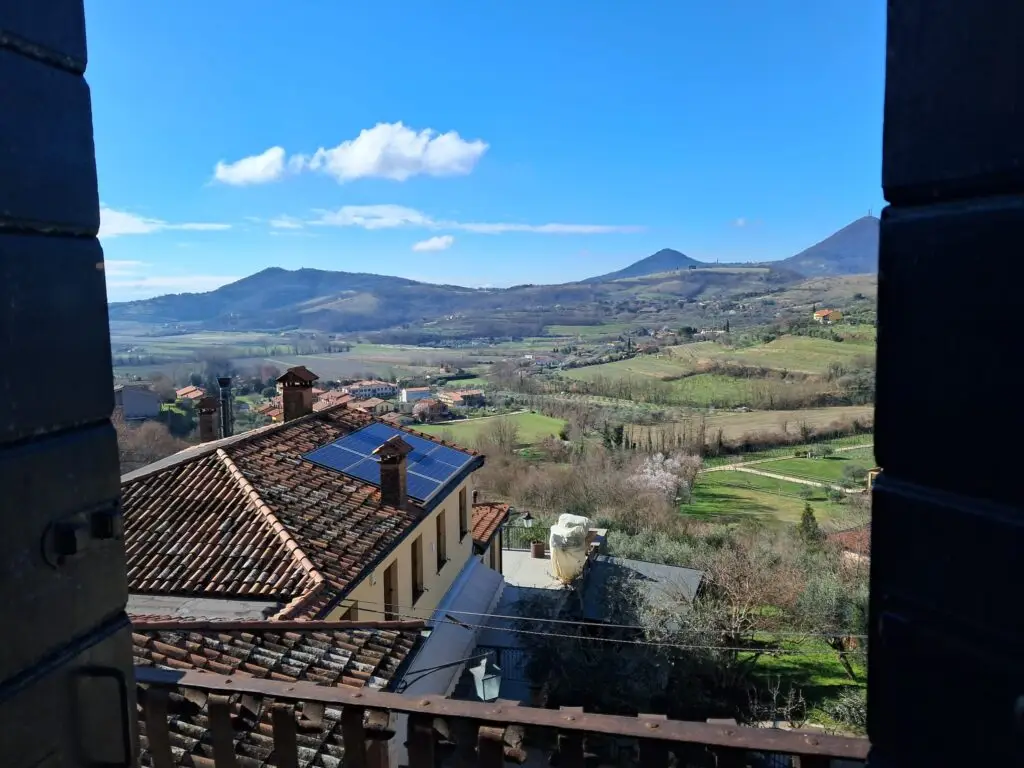
From the French-door balcony, now bordered by an iron railing (which replaced the original wooden balcony in 1690), visitors can enjoy a beautiful view: Mount Cero in the background, Mount Castello to the right, and the small village of Calaone to the left — the very same panorama Petrarca himself once admired.
3) PETRARCA’S STUDY
This is the room where Francesco Petrarca spent his final moments, dying during the night between July 18 and 19, 1374. For a long time, the space was divided into three smaller rooms, but in the 1919 restoration it was returned to its current configuration as a single space.
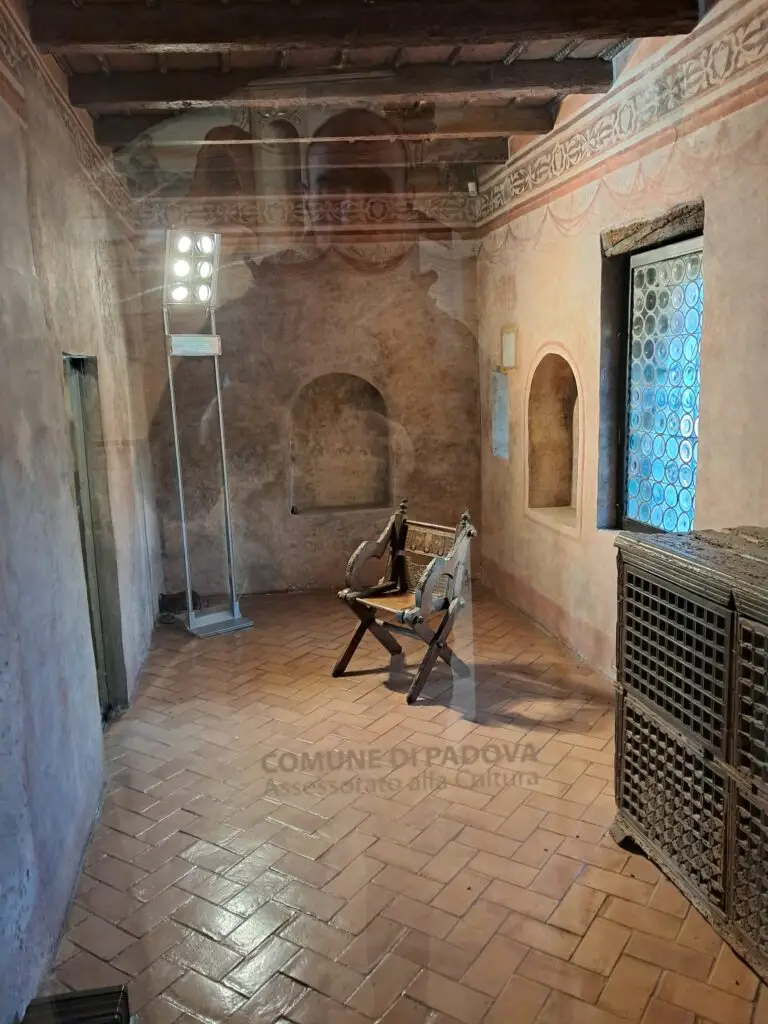
The walls still bear traces of 14th-century decoration — colored bands and a frieze with a recurring coat of arms, interspersed with flowers and red-and-green drapery motifs. The partially deteriorated shield shows a golden bar on a blue field, identified as Petrarca’s family emblem.
In the study, visitors can see a chair and a bookcase-cabinet traditionally believed to have belonged to the poet — a tradition dating back to the 16th century. However, not all furnishings can be confirmed as original, since several copies and reconstructions were made over the centuries.
4) ROOM OF VISIONS
This room is decorated with paintings inspired by “The Song of Visions” (Canzoniere, no. 323), an allegorical poem in which Petrarca describes symbolic images related to life, love, and death.
Starting from the painting to the left of Petrarca’s portrait and proceeding counterclockwise:
4A) The stag pursued by hounds
The stag pursued by hounds — beauty assailed by the opposing forces of good and evil, represented by the black and white dogs.
(original Italian text) «Una fera m’apparve da man destra, con fronte humana… cacciata da duo veltri, un nero, un biancho»
“A beast appeared to me on the right, with a human face… hunted by two hounds, one black, one white.”

4B) The ship tossed by the storm
the fragility of human life, driven by the wind and threatened by the sea.
(original Italian text) «Indi per alto mar vidi una nave…»
“Then I saw on the high sea a ship…”

4C) The shattered laurel
the symbol of poetic glory struck down by the storm of fate.
(original Italian text) «In un boschetto novo i rami santi fiorian d’un lauro…»
“In a fresh grove the sacred branches of a laurel blossomed…”

4D) The spring swallowed by the earth
beauty and joy suddenly vanishing.
(original italian text) «Chiara fontana in quel medesmo bosco sorgea d’un sasso…»
“A clear spring rose from a rock in that same grove…”

4E) The phoenix turning upon itself
ending its life to be reborn, representing the cycle of death and rebirth, an image of spiritual transformation.
(original italian text)«Una strania fenice, ambedue l’ale di porpora vestia…»
“A strange phoenix, her wings both clad in purple…”

4F) The death of Laura
the poet’s greatest sorrow: the loss of his beloved, destined for heaven.
(original Italian text)«Alfin vid’io per entro i fior et l’erba pensosa ir sì leggiadra et bella donna…»
“At last I saw, among the flowers and grass, a pensive and graceful lady walking…”

The Portrait of Petrarca
Next to the visions stands the portrait of the poet as remembered in the 16th century, when the paintings were made.

5) ROOM OF CLEOPATRA OR OF THE AFRICA
This room is also known as that of “Africa” or “Lucretia.”
The first name refers to the wall paintings inspired by Petrarca’s Latin epic Africa, recounting the deeds of Scipio Africanus.

The second name comes from the painted stucco relief above the door to the small right-hand chamber, depicting the Roman heroine Lucretia.

On the fireplace, Cleopatra is painted as she is bitten by asps.

Also depicted is the poetess Sappho — on the left, writing in her study, and on the right, throwing herself from the Leucadian cliff.

On either side of the fireplace are two more paintings.
On the right wall: Cleopatra’s banquet with Mark Antony and Enobarbus, where the queen of Egypt dissolves a pearl in a cup of wine — a symbol of her disdain for wealth.

On the left wall: a scene showing a king with his hands tied behind his back, led by a soldier before a woman — likely Ptolemy, Cleopatra’s captive brother, presented to her by Julius Caesar.
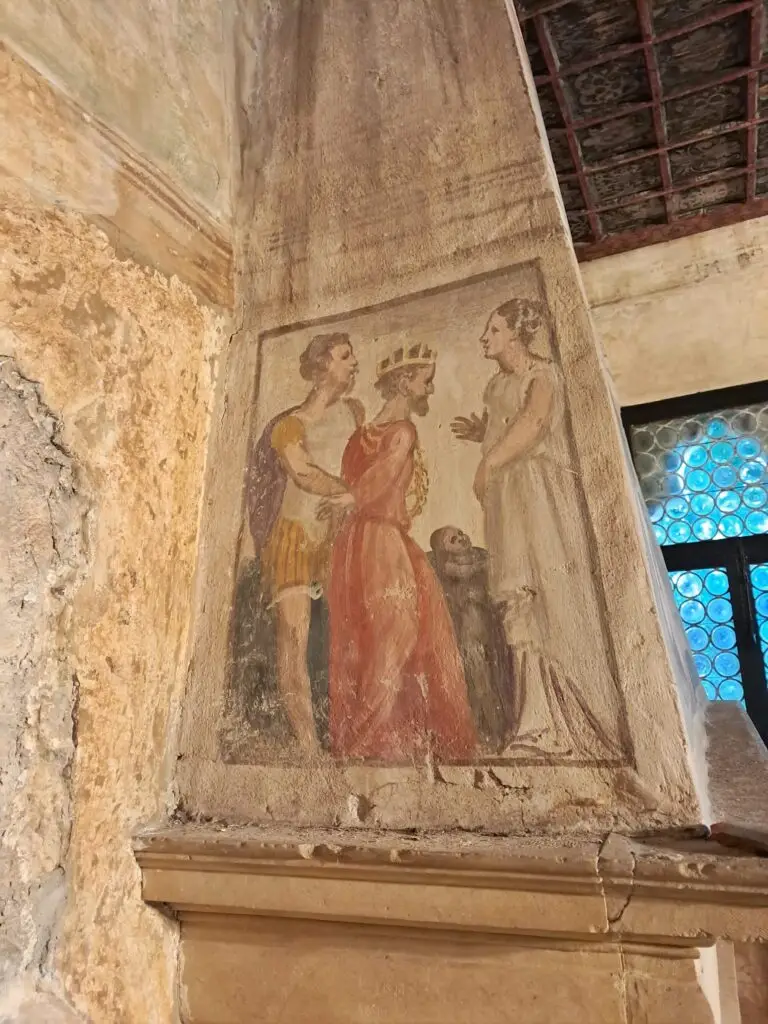
The three women depicted in this room — Cleopatra, Lucretia, and Sappho — are united by their tragic suicides and are all mentioned in Petrarca’s Trionfi.
6) SMALL RIGHT AND LEFT ROOMS (AUDIO MISSING) (audio non ancora realizzato, migliora la sezione della gatta, poi procedi)
These were service rooms of the main residential area, serving as passageways to the “rustic” section. There are no traces of decoration, likely absent from the beginning.
7) GROUND FLOOR
Petrarca’s Cat
According to tradition, this is the embalmed cat of Petrarca, his domestic companion, as depicted in the Sala dei Giganti in Padua.


In reality, it was a prank by Gabrielli, the owner of the house in the early 1600s.
The cat was kept on the first floor above the door of the Room of Venus until 1970, when it was moved to the ground floor.
(AGGIUNGI TENTATIVO DI FURTO)


